
In eleven months, Fayette County workers removed 32 tons of roadside trash. Their work deserves our gratitude—and a future that asks less of them.
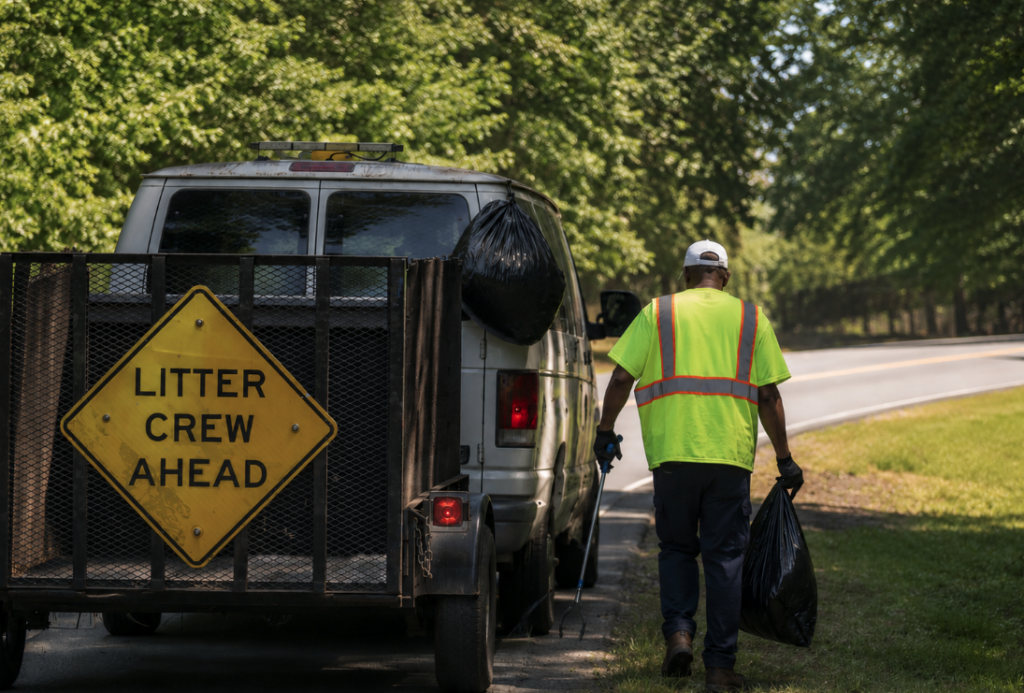
A recent Fayette News feature followed a small Fayette County Road Department crew down Redwine Road on an early summer morning. Their van moved from Fayetteville toward the county border, and at the roundabout at South Peachtree Parkway, the day’s assignment began.
As the van traveled, the crew scanned the roadside. When it stopped, the workers moved quickly. Empty water bottles, fast-food wrappers, scraps of paper – whatever had landed in the grass or been thrown from a passing car – went into black bags. Then the van moved on.
This is how a county road becomes clean again – not all at once, and not by accident.
Most of us experience a clean roadside as an absence. Nothing jarring catches our eye, nothing manmade rolls beneath a tire or gathers in a drainage ditch. We pass through without wondering who was there before us, making the ordinary look ordinary again.
Tammy Walker is one of those people.
“We don’t mind picking up bottles and things; just be mindful,” she told the county.
It is the kind of request that sounds almost too modest for the work behind it.
The Fayette County Road Department maintains more than 500 miles of right-of-way and another 50 miles of gravel roads and prescriptive easements. The litter crew’s days run nine hours. Walker came to the department after working in health care. She found coworkers who were willing to teach and a crew that, in her telling, works with diligence and mutual respect.
There is pride in the work.
Fayette County Road Department employees say motorists should be able to notice a difference when they cross the county line. The roads look tidy, and the shoulders look cared for. That difference is due to the people who ride in a county van, filling black bags one roadside at a time.
Between July 1, 2025, and May 31, 2026, Fayette County workers collected 32 tons of trash.
Thirty-two tons.
It is roughly 64,000 pounds of bottles, wrappers, bags, paper, and discarded debris collected in one county over eleven months. It is 64,000 pounds that someone had to see, stop for, pick up, bag, load, and carry away.
Across Georgia, public employees, sanitation workers, nonprofit organizations, and volunteers are doing versions of the same job. Georgia DOT spends more than $10 million each year removing litter from state roads – a massive, recurring public expense for a collection system that leaves communities paying to recover the same material year after year. Meanwhile, in 2025, Rivers Alive volunteers removed more than 916,000 pounds of trash from Georgia waterways.
If those numbers tell us anything, it’s that Georgia is not a state that doesn’t care about litter.
Quite the opposite.
Thousands of volunteers spend weekends cleaning rivers. County crews patrol roadsides. State transportation workers remove litter year-round. Local organizations organize cleanups, install trash traps, and mobilize neighbors who are willing to give up a Saturday morning because they believe the places around them are worth protecting.
The remarkable thing is not that people are failing to try.
It’s that despite all that effort, there is still this much left to collect.
Every bottle beside a road is evidence that something failed earlier. Someone manufactured it, someone distributed it, someone bought it and ate it, drank it, finished and then…
Somewhere between being used and being picked up from a roadside, the system stopped working.
By the time that bottle reaches the shoulder of a county road, the consumer may be finished with it.
The community is not. That matters for taxpayers, for neighborhoods and, ultimately, our waterways.
Roadsides are not separate from the rest of the watershed. Rain carries loose debris into drainage ditches, storm drains, creeks, and rivers. What begins as roadside litter often becomes water pollution.
By then, a valuable material that could have been collected, processed, and returned to the manufacturing supply chain has instead become a public tax liability. Whether trash is tossed from a window, escapes from an open truck bed, or blows out of an unsecured container, the destination is the same.
A crew still has to stop.
A county still has to pay.
Fayette County Assistant Road Department Director Bradley Klinger has suggested several ways residents can show appreciation for the crew: slow down when passing workers, offer a word of thanks, share a positive message about their work, or arrange to sponsor lunch. Residents can also report trash escaping from garbage trucks to the hauling company and report roadside dumping to the Sheriff’s Office or Marshal Department.
Those are good things to do, but appreciation can go further.
The greatest thank-you we can give a litter crew isn’t a free lunch, a social media post, or a wave from a passing car, it’s a lighter workload.
Cleanup crews will always be essential. So will volunteers.
But cleanup should be the last line of defense, not the whole plan.
The Fayette County litter crew’s story isn’t really about trash.
It’s about value.
Every bottle they collect started as something valuable. It was manufactured, shipped, purchased, consumed, and thenbecame worthless.
A few minutes later, it became expensive again.
Not to the person who threw it away, but to the Fayette County taxpayers.
That’s the economic problem.
When something valuable is allowed to lose all of its value at exactly the wrong moment, communities inherit the cost. County workers spend their mornings picking it up, volunteers spend weekends pulling it from rivers, taxpayers foot the bill, and manufacturers lose material that could have gone back into the supply chain.
Tomorrow morning, Tammy Walker and the rest of the Fayette County litter crew will climb back into their truck.
They will drive another stretch of road.
They will spot another bottle.
They will stop.
When they drive away, Fayette County will be a little cleaner than it was that morning, and we absolutely should thank them for that.
But then we should build a system that gives them fewer bottles to pick up next year than they did this year.